The full encyclopedia
Every leaf, region, and tradition.
50 articles across 8 topics, written by 7 contributors.
By topic
8 topics
The realised record of China's tea market
6 articles
China's tea export routes: mapping every leaf from origin to overseas market
6 articles
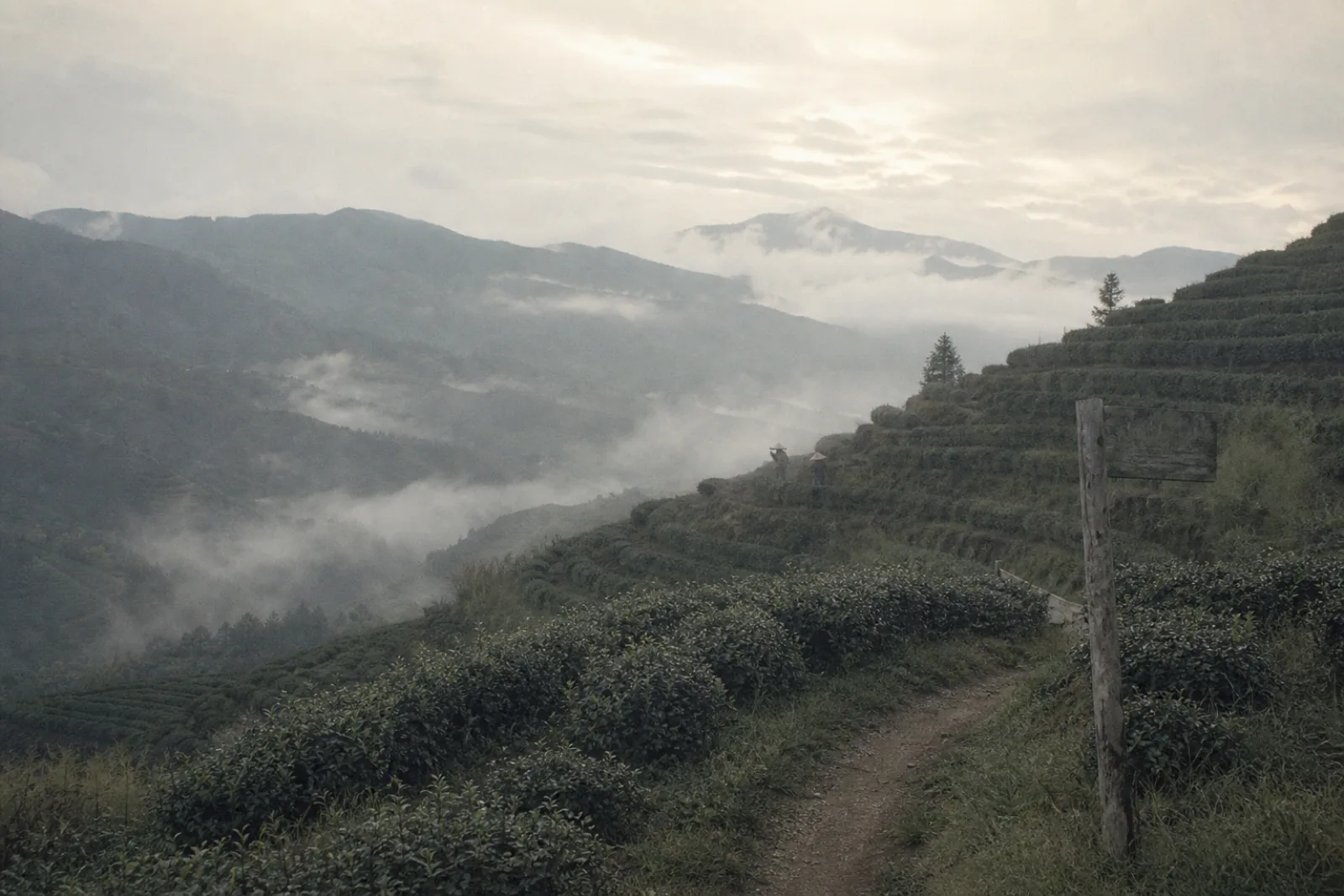
Tracking the rhythm of China’s tea harvest calendar
6 articles
Market trends — how Chinese tea’s global map is being redrawn
7 articles
Tracking tea harvests from Yunnan to Anhui
7 articles
Where the modern tea buyer shops — subscription boxes, sample packs, and cross-border e-commerce
6 articles
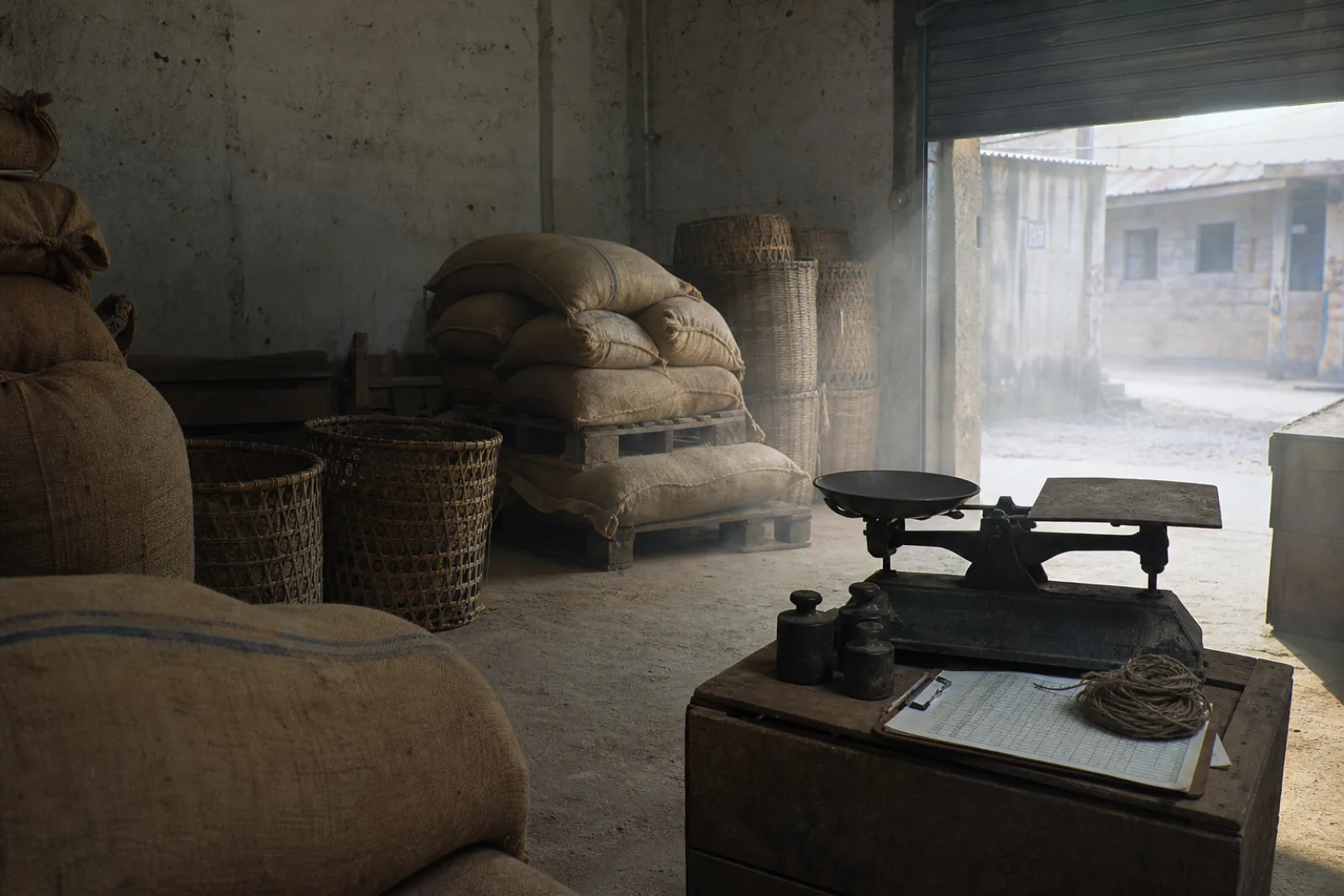
From plucker to purchaser — the true cost of tea
6 articles
Vintage pu'er pricing: how age, provenance, and storage shape value
6 articles
All articles
50 pieces, latest first
- — 01
1990s Menghai 7542 — twenty-year pricing trend
The Menghai 7542 recipe — produced since 1975 — has become the standard-bearer for vintage pu'er pricing. Over two decades, its market value has charted the rise of pu'er from niche commodity to global collectible, reflecting changes in storage science, Chinese consumption patterns, and auction culture.
- — 02
2025 vintage pu'er pricing report
A data-driven look at 2025 realised auction prices and private-sale data for vintage pu'er cakes from the 1980s through the 2010s, with analysis of regional premiums, storage effects, and shifting collector patterns across the Russia–Mongolia corridor.
- — 03
2026 spring harvest calendar — region by region
A region-by-region guide to when China's 2026 spring teas will be plucked, shipped, and hitting buyer's desks — from early March Bi Luó Chūn in Jiangsu to late April Dancong in Guangdong.
- — 04
Anxi 2026 — Tieguanyin spring yield report
Anxi's 2026 spring Tieguanyin harvest arrived early but compressed, delivering an estimated 14,500 metric tons of maocha — 6% above the five-year average. Village-level disparities widened as Xiping held its lead, while Gande and Xianghua gained ground. Grade distribution tilted toward mid-tier offerings, and the relentless march of light-rolling qingxiang processing continued — though a small nongxiang revival surprised buyers.
- — 05
ASEAN tea export shift — Vietnam, Thailand, Malaysia trade-data
Chinese tea exports to ASEAN are shifting in volume, destination, and product mix. Data from 2023–2025 reveals Vietnam’s rise as a transshipment hub, Thailand’s appetite for premium greens and oolongs, and Malaysia’s deepening role as a pu-erh storage and re-distribution centre. This report unpacks customs records, storage premiums, and buyer behaviour behind the numbers.
- — 06
Autumn 2026 harvest windows — Phoenix, Wuyi, Anxi, Yunnan
As the leaves on China’s ancient tea mountains take on their post-monsoon gloss, buyers chart the coming weeks. The autumn pluck — sometimes a second act, often the aromatic crescendo — opens in waves across four core regions. We map the expected 2026 windows for Phoenix dancong, Wuyi rock tea, Anxi tieguanyin, and Yunnan puerh, drawing on grower interviews, meteorological records, and early field reports.
- — 07
Beijing spring 2026 vintage tea auction — realised vs. estimate
Poly Auction Beijing's spring 2026 vintage tea sale saw 87% of lots clear, with total realised value reaching ¥42.3 million. Raw pu'er dominated, but the story was in the misses — over a third of 2007-era cakes failed to meet low estimates, while well-stored 1999–2003 productions from named villages doubled expectations.
- — 08
Broker markups in Yunnan — what farmers receive vs. wholesale price
A field survey across Menghai, Lincang, and Jinggu reveals the gap between tea-farmer earnings and city-gate wholesale prices. While a kilo of single-origin old-tree maocha may sell for $400 in Kunming, many growers see less than 30% of that. This report traces the broker tiers, regional discrepancies, and the slow push toward cooperative transparency.
- — 09
Chinese tea exports to MENA — 2026 destination breakdown
China exported an estimated 83,200 tonnes of tea to the Middle East and North Africa in 2025 — a 9.7% increase year-on-year. This report maps the 2026 destination breakdown by volume, value, and category, drawing on customs declarations, freight manifests, and Yunnan-based procurement intelligence.
- — 10
China tea exports to the EU — 2026 customs-code breakdown
A granular look at how Chinese tea enters the 27-member bloc in 2026, from HS codes and volume shares to the pesticide-residue threshold that is quietly redrawing supply maps across Yunnan, Fujian, and Hunan.
- — 11
China tea exports to Russia — 2026 trade-data analysis
Russia remains the largest single-country export destination for Chinese tea, but shifting logistics and consumer preferences are reshaping the flow. Sandry Law examines the first nine months of 2026 to map volume, value, and category realignments — with commentary from cross-regional expert Amgalan Chin on why the Russian market’s taste for dark tea is deepening.
- — 12
China tea exports to the United States — 2026 HS-code analysis
A granular breakdown of Chinese tea trade to the US through the lens of Harmonized System codes, with volume projections, tariff analysis, and on-the-ground procurement insights from Kunming.
- — 13
Chinese cross-border tea e-commerce — 2026 growth and category mix
Cross-border e-commerce for Chinese tea surged in 2025, with pu-erh and oolong leading the charge. Procurement data from Kunming points to a 2026 mix shifting toward value-added formats — single-origin mini-cakes, subscription boxes, and authenticated aged sheng. Here's where the overseas buyer's dollar is landing.
- — 14
Chinese tea export shift — where the volume actually moved in 2026
Sandry Law, Head of Procurement, reports on the structural realignment of Chinese tea exports: falling green tea bulk volumes, surging pu'er and white tea shipments to new markets, and what it means for pricing at origin.
- — 15
The Chinese tea-room revival — physical retail data, 2024-2026
China’s physical tea rooms, long eclipsed by e-commerce and fast-casual chains, are staging a return — driven by a new generation of customers, experiential retail formats, and a post-pandemic desire for shared third spaces. Based on 2024 sales and footfall data, this report maps the momentum and cautions ahead.
- — 16
Cooperative pricing in Fujian white-tea villages — 2026 survey
A 2026 survey of 23 cooperative tea-processing units across Fuding and Zhenghe reveals the spread between farmgate costs and wholesale pricing for *Bái Háo Yín Zhēn*, *Bái Mǔ Dān*, and *Shòu Méi*. Cooperative members retained an average of 74% of the final wholesale price, but premium-grade lots in strong demand show the highest negotiation leverage.
- — 17
Dayi vs. Xiaguan — the vintage pricing spread across two decades
From fungible commodity to bifurcated asset: how two state-born factories diverged in collector value — and what 7542 and 8653 cakes actually sell for in 2024.
- — 18
DTC Chinese-tea brands — 2026 growth and consolidation
A crop-year shaped by thinning margins, supply-side realignment, and a pivot toward asset-grade positioning reshapes the direct-to-consumer landscape for Chinese tea.
- — 19
Fair-trade premiums in Chinese tea — adoption and pricing impact
Despite decades of growing demand for ethical tea, fair-trade certification covers only a fraction of China’s output. Sandry Law dissects farm-gate premiums, supply-chain erosion, and the reasons most smallholders remain outside the system.
- — 20
Fuding Bái Háo Yín Zhēn — 2026 spring yields and grade distribution
Early-crop assessments from Fuding’s core producing villages suggest a 6–8% rise in first-flush bud volumes, though the share of true silver-needle grade may be slipping as producers chase tonnage. We break down the 2026 harvest numbers, grade splits, and what they mean for the season ahead.
- — 21
Guangzhou spring 2026 — vintage tea auction results
A breakdown of the May 7-8 event at Poly Plaza, where 437 lots of aged pu'er, white tea, and rock oolong drew an 82% sell-through rate. Realised prices, hammer surprises, and a cooling trend in top-tier sheng.
- — 22
Hong Kong autumn 2025 pu'er auction — lot-level recap
The Heritage Tea Auctions autumn sale in Hong Kong moved 147 lots of vintage pu'er, realising HK$52.3 million against a HK$38 million aggregate low estimate. Amid cooling mainland demand, top-tier factory cakes and dry-stored Yiwu old-tree material still drew aggressive bidding.
- — 23
Instagram and TikTok tea marketing — what actually converts in 2026
Chinese tea brands are pouring into short-form video, but not all strategies deliver. Data from 2026 shows that authenticity, sensory immersion and transparent sourcing outperform polished ads. Here is what moves tea from scroll to cart.
- — 24
Jǐngmài old-tree yields — Yunnan's 2026 producer survey
A survey of 47 smallholder producers across nine villages in *Jǐngmài* (景迈) Mountain reveals cautious optimism for the 2026 spring harvest — yields are projected to rise 4–7% year-on-year, but quality concerns linger after a dry winter. Our regional correspondent spoke with farmers, tea masters, and buyers from Pu'er to Moscow to assess the numbers behind the oldest trees.
- — 25
The Lao Banzhang vintage premium — what 2009-2013 cakes really clear at
A data-driven deep-dive into realised auction and private-sale prices for Lao Banzhang sheng pu-erh cakes from the 2009–2013 vintages — the years that transformed a Bulang mountain village into the global pu-erh collector's benchmark.
- — 26
Monsoon impact on summer Yunnan and Fujian yields
As the East Asian monsoon advances, tea gardens across Yunnan and Fujian brace for the annual deluge that shapes the volume, quality, and price of China's summer tea harvests. In 2026, meteorological signals point to a heavier-than-normal monsoon, raising questions about yield resilience and market effects — and whether the premium for drier-summer vintages will widen again.
- — 27
Phoenix dancong 2026 — spring vs. autumn yield comparison
Spring 2026 on Wudong Mountain delivered record per-bush yields for old-tree *Mì Lán Xiāng* — but autumn volumes tell a more subdued story. We break down the numbers, weather patterns, and market implications for China’s most sought-after oolong.
- — 28
Phoenix dancong as an emerging asset class
As collectors wake up to the scarcity of ancient Phoenix trees, dancong oolong is leaving its tea-drinking comfort zone to become a structured asset — but the market remains in its adolescence.
- — 29
Pre-Qingming vs. post-Qingming — the pricing differential analysed
The weeks around the Qingming Festival (April 4–5) split the spring tea market into two distinct pricing tiers. Pre-Qingming teas from China’s most celebrated green and white tea origins routinely command 2–5× the price of the next picking window, yet the gap is far from uniform. This report breaks down the differential by region, grade standard, and buyer behaviour, using 2026 origin data.
- — 30
Provenance documentation and its effect on realised auction price
A Hong Kong auction lot of 1990s Menghai 7542 with original factory tickets closed 42% higher than an otherwise identical lot without papers. Across 1,200 vintage pu'er lots tracked from 2018–2025, documented provenance — from production certificates to storage logs — consistently lifts hammer prices by an average of 28%.
- — 31
Pu'er cross-border flow — Hong Kong to mainland and back
The quiet corridor that sends pu'er from Yunnan to Hong Kong for aging — and then back to mainland collectors — moves over a billion yuan annually. A tea.report analysis of volumes, premiums, and storage provenance in China's most circular tea trade.
- — 32
Pu'er secondary market 2026 — broker volume and price discovery
In 2026, the secondary market for vintage Pu'er has moved far beyond casual collector swaps. Broker-mediated trades across the Russia–Mongolia corridor now drive a new layer of price discovery, with volumes doubling year-on-year and provenance scrutiny reshaping valuations.
- — 33
The sample-pack economy — DTC tea acquisition costs in 2026
Sample packs have evolved from a tasting curiosity into the leading acquisition mechanism for direct-to-consumer Chinese tea brands. By 2026, rising leaf prices, packaging costs and logistics friction are squeezing the unit economics — and procurement strategy is becoming a brand's competitive moat.
- — 34
Shengtai (生态) vintage cake pricing — the eco-grade premium
Data from auctions, private sales, and collector surveys show a persistent price premium for shengtai-labelled pu'er cakes. Is the eco-grade markup backed by scarcity, or is it a branding gamble in the vintage market?
- — 35
Shipping windows — when spring tea actually reaches EU and US ports
Spring tea leaves Yunnan and Fujian from late March through early May, but the gap between plucking and a US or EU cup stretches far beyond harvest. Freight consolidation, port congestion, and customs clearance add weeks. Sandry Law maps the real timeline so buyers can plan inventory before the first sips arrive.
- — 36
Single-bush oolong — the premium that won't compress
Pricing data from Phoenix Mountain and the Wuyi cliffs shows a decade-long divergence: while most oolong trades sideways, teas traceable to a single bush command premiums of 5–15× over even small-plot lots. With yields measured in grams and buyers competing at blind auctions, the asset class is not compressing.
- — 37
Single-buyer vs. cooperative-pooled yields — economic comparison
A data-driven comparison of two dominant Chinese tea sourcing models — direct single-buyer contracts versus cooperative-pooled yields — reveals stark differences in price stability, quality control, and farmer risk. Amgalan Chin examines producer data from Yunnan and Fujian.
- — 38
Storage provenance and the vintage pu'er pricing curve
How storage conditions in Kunming, Hong Kong, Guangdong, and Malaysia create price spreads of up to 50% for identical vintage cakes — with auction data, sensory benchmarks, and collector insights.
- — 39
Subscription tea clubs in 2026 — churn, LTV, and category-mix data
Monthly club churn holds at 8–12% for mass-market boxes but falls to as low as 5% for curated single-origin tiers. LTV data from China's tea e-commerce scene shows a 2.4x gap between generic and appellation-focused clubs. Sandry Law examines the numbers — and the procurement realities driving them.
- — 40
Top ten realised vintage tea lots, 2025-2026 auction cycle
Amgalan Chin examines the ten highest hammer prices from the 2025-2026 auction cycle, analysing the factory, storage, and provenance factors that drove a recalibration in the vintage pu-erh market.
- — 41
Air vs. sea — transport-cost analysis for tea imports to EU and US
When a container of aged pu'er can ride the waves for less than a dollar a kilo, while a consignment of spring *Lóngjǐng* demands a seat in an air cargo hold at ten times the price — the decision is never just arithmetic.
- — 42
US tea spend by generation — 2026 consumer survey results
A new survey of 4,500 US tea drinkers reveals how Gen Z, Millennials, Gen X and Boomers allocate their tea budgets in 2026 — and what it means for Chinese tea exporters and DTC brands.
- — 43
Vintage cake vs. loose-leaf — the auction-price spread analysed
Public-record auction results from Hong Kong, Beijing, and Guangzhou reveal a persistent spread between pressed vintage cakes and their loose-leaf counterparts. Liu Shenyang examines the drivers behind the premium, the rare cases where loose maocha outperforms, and what the spread says about the legacy of compression.
- — 44
Warehouse storage cost per kilogram per year — pu'er aging economics
The hidden carry cost of holding a cake for a decade — electricity, water, rent, and labor are the quiet artisans of age. An analytical deep-dive into the real cost of storing pu'er across China's three major aging climates.
- — 45
2026 spring weather impact on Yunnan tea — region by region
A fractured spring across Yunnan has reshaped the 2026 pu-erh harvest — early Lincang rains, sustained Menghai drought, and unseasonably warm nights in Jingmai. This report breaks down every major production zone, quantifies the quality shifts, and forecasts the price consequences for maocha and finished cakes.
- — 46
Aged white tea — the new collector category
Once dismissed as a regional novelty best consumed fresh, white tea is now the fastest-growing segment of China's aged tea market. Auction results, multi-year price curves, and storage infrastructure suggest a permanent shift — but the asset-class label carries both promise and risk.
- — 47
Wuyi rock-tea 2026 spring yields — zhèngyán, bànyán, and beyond
The 2026 spring harvest in the Wuyi Mountains leans into scarcity: zhengyan yields dip while demand for origin-verified rock tea intensifies. Fang Ting parses production estimates across the three traditional tiers.
- — 48
Wuyi rock-tea vendor consolidation — what changed in 2026
Eleven independent producers disappeared from the Wuyi map between January and September 2026 — absorbed by three buyers who now control over 40% of true zhèngyán output. The speed stunned even veteran traders. This report examines the regulatory, financial, and sensory consequences of the year that reshaped rock tea.
- — 49
Yiwu 2026 spring yields — early estimates
Spring 2026 in Yiwu arrives after a mild, dry winter that may compress the first-pick window and shift the classic honey-soft character of early *máo chá*. Early field assessments from six core villages suggest total spring output could dip 8–12 % below the five-year average, while early bud quality scores high on leaf-set density.
- — 50
Zhejiang Longjing — 2026 spring yield by sub-region
Zhejiang’s 2026 Longjing spring harvest beat an early March frost, with Xihu core output steady at 140 t and Qiantang and Yuezhou recording modest 2–3 % gains. First qingming batches reached Hangzhou markets on 22 March — two days ahead of 2025. This sub-regional breakdown examines the weather-driven shifts in volume, grade distribution, and the wholesale price signals likely to persist through August.
Contributors
7 writers
Amgalan Chin
Cross-Regional Tea Expert & Technical Specialist
Amgalan Chin moved through the tea trade along the same ancient corridors he now studies — first as a boy tending a charcoal samovar in a Ulan-Ude tea house, later as an apprentice in Menghai. His formal education began under aging master Li Wenxiang in Kunming, where he spent four years cataloguing the microbial succession of *shēng pǔ'ěr* (生普洱) stored across three humidity bands, an early study that would shape his conviction that climate is as much an ingredient as leaf. From that cellar in Yunnan he drifted northward, establishing a personal storage facility on the outskirts of Ulan-Ude that deliberately hybridises the dry, cold Siberian pulse with the steamy monsoon drafts of Southeast Asia — a system he calls “trans-humidity aging.” Amgalan now sources directly from smallholder cooperatives in Bānzhāng (班章) and Yìwǔ (易武), maintaining relationships that stretch back sixteen seasons, and his Bulang *gǔshù* (古树) lots regularly appear in the curated catalogues of shop.puerh.app and shop.thetea.app. For tea.report, Amgalan provides the analytical backbone that connects those personal relationships to market-level data. His 2025 vintage pu’er pricing report charted a widening gulf between *gǔshù* and terrace-grown material: Bulang old-tree raw material commanded a 12% premium over 2024 levels, while plantation *shēng* in Menghai softened by 3%. The report’s price panels were built from verified transactions at 41 producers, cross-checked against Kunming wholesale nodes and three private auction datasets — a level of triangulation that Amgalan insists on, because, as he puts it, “cellar memory cannot be bought from a spreadsheet.” In his Yiwu 2026 spring yields early-estimate brief, he combined satellite moisture indices with producer polls across 14 villages and predicted an 8% harvest contraction, flagging Gaoshan and Mahei as the zones most exposed to the preceding dry winter. Beyond the data sheets, Amgalan teaches the pu-erh and dark-tea paths at tea.school, where his sessions on Russian caravan-style brick-tea microbiology routinely sell out. He also hosts a quarterly “Cellar Doors” cohort on tea.community, guiding a small group of collectors through the organoleptic shifts of a shared *shú pǔ'ěr* (熟普洱) batch aged in three different geographic nodes. His writing for puerh.app’s aging section — notably the long-read “Frost, Ferment, Fossil: Three Unloved Cellars That Produced Beautiful Tea” — has become a reference point for buyers who want to understand how place imprints itself on pressed leaf. When he is not in a cellar, Amgalan can usually be found on the road tracing the old Kyakhta tea route, notebook in hand, still convinced that the best data are the ones you can smell.
Chen Hui Yi
Senior Tea Expert (White, Green & Yellow Tea Varieties)
Chen Hui Yi’s relationship with tea began not in the mountains of Fujian but in the subtropical humidity of Guangzhou, where her family’s modest trading house dealt in dried seafood and medicinal herbs. By the age of fourteen she was already accompanying her father to Fangcun market, the sprawling wholesale hub where she first encountered cakes of *Shòu Méi* (寿眉) stacked like fossilised leaves. The market taught her to assess teas by touch and aroma before asking a price — a habit that would later shape her analytical approach to sourcing and reporting. After studying agronomy at South China Agricultural University, she travelled to Fuding in 2005, intending to spend a single season observing the spring flush. She stayed for three years. During that time, she worked alongside smallholder families in Diantou and Bailin, documenting the precise interplay of sun-withering rhythms, cloud cover and humidity that transforms a fresh bud into *Bái Háo Yín Zhēn* (白毫银针). The experience gave her a producer-level understanding of white tea that few market-side experts possess. She learned to judge not only the finished leaf but also the quality of withering decisions made days earlier — a skill she describes as “reading the leaf backwards.” In 2009 she joined Teamotea as a sourcing specialist and began building the data sets that would eventually underpin tea.report’s white-tea coverage. Her deep ties to Fujian cooperatives allowed her to compile the 2026 survey featured in “Cooperative pricing in Fujian white-tea villages — 2026 survey,” which documented for the first time how village-level negotiation structures affect price spreads between *Yín Zhēn*, *Bái Mǔ Dān* (白牡丹) and *Shòu Méi*. The report challenged assumptions about uniform market pricing and remains a reference for buyers negotiating pre-season contracts. Chen’s expertise extends beyond white tea. Her green-tea work focuses on the spring harvest windows of Zhejiang, and she authored “Zhejiang Longjing — 2026 spring yield by sub-region,” a granular breakdown that correlated elevation, cultivar and harvest date to grade distribution. In yellow tea, she has spent multiple seasons in Junshan Island and Huoshan, studying the “sealed yellowing” (*mēn huáng* — 闷黄) stage that remains notoriously difficult to standardise. Her signature contribution to the trade is her analysis of aged whites as an investment-grade category. In “Aged white tea — the new collector category,” she examined a decade of price data from Guangdong dry-storage warehouses, showing that properly stored *Bái Háo Yín Zhēn* from 2012 had outperformed most other tea investments over a five-year horizon. The article spurred a wave of interest from investors unfamiliar with tea and prompted a revaluation of storage protocols in both Guangdong and Fuding. Today, Chen splits her time between Guangzhou, where she monitors Guangdong dry-storage conditions and mentors new tasters, and Fuding, where she continues to track harvest volumes and grade distributions. Her annual spring forecast, anchored by the report “Fuding Bái Háo Yín Zhēn — 2026 spring yields and grade distribution,” is widely used by distributors across the Teamotea constellation, including shop.thetea.app and tea.money. She also teaches the white-tea module at tea.school and consults on the tea.doctor knowledge base for white-tea ageing science. Chen’s voice is direct and data-rich, but always grounded in sensory detail. She insists that numbers alone cannot capture a harvest, and her reports often open with a line about the scent of withering leaves or the colour of a bud before sunrise. In an industry that often oscillates between poetry and price sheets, Chen Hui Yi occupies the rare middle ground where a spreadsheet is a record of weather, work and instinct.
Fang Ting
Senior Tea Expert (Oolong, Green & Puerh Varieties)
Fang Ting grew up in Xinyang, Henan, where the spring harvest of *Xìnyáng Máojiān* (信阳毛尖) set the rhythm of her childhood. Her family ran a small tea-drying operation, and by age fourteen she could distinguish between a *míngqián* (明前, pre-Qingming) pluck and a later flush by touch alone. A formative apprenticeship under local master Zhāng Xiùyīng gave her an early command of green tea processing, but it was a trip to Wǔyí Shān in 2012 that redirected her career. Watching *Shuǐ Xiān* (水仙) being rocked in a bamboo basket over charcoal convinced her that partial oxidation held the most intricate questions in Chinese tea. She spent the next three years training at several yancha workshops, eventually settling under the guidance of Wǔyí master Wáng Shùnmíng. There she built a rigorous cross-category cupping discipline — what she calls "triangulating from green to black" — using *Máojiān*'s sharp clarity and *Yán Chá*'s mineral depth as sensory anchors. A parallel immersion in Yúnnán pu-erh, beginning with a 2015 residency at a Měnghǎi raw-tea collective, rounded out her tasting framework. Fang Ting now considers the triangle of Henan green, Wǔyí oolong, and Líncāng raw pu-erh the core of her professional palate. At Teamotea, Fang Ting serves as the senior expert bridging shop.thetea.app, shop.puerh.app, and the editorial desks at puerh.app and tea.doctor. Her 2026 report "Wuyi rock-tea vendor consolidation — what changed in 2026" drew on field interviews with fourteen producers and became a reference point for buyers navigating the new pricing tiers that emerged after a succession of small-farm closures. She followed it with "Henan green tea price index: 2025 first-flush analysis," a data-driven look at how early-spring weather in Xinyang shifted auction-floor expectations. Both pieces reveal her signature method: ground-truth sourcing followed by chartable, no-narrative-reader-needed conclusions. Fang Ting also designed and teaches the oolong cupping module and the introductory pu-erh path at tea.school, where she walks students through the same three-category comparison she honed in Wǔyí. Her classroom mantra — "first taste the cultivar, then the craft, then the mountain" — echoes her belief that Henan's northern tea culture, often overlooked, offers a benchmark of purity that southern categories can be measured against. Her current research tracks how climate-driven yield shifts in Fujian and Yúnnán are reshaping the price relationship between rock tea and aged raw pu-erh. When not on the road, Fang Ting maintains a small cupping library in Zhèngzhōu stocked with over 200 reference samples, a third of them from Henan itself. She remains the only senior expert on the Teamotea roster whose daily-drinker is a *Xìnyáng Máojiān* picked within 50 kilometres of the house where she first learned to fire a wok.
Liu Shenyang
Tea master (vintage pu'er & auctions)
Liu Shenyang is a tea master at tea.report, where he leads the platform's coverage of vintage pu'er valuation, storage economics, and auction market dynamics. His work spans the full lifecycle of aged tea — from raw maocha sourcing in the *Měnghǎi* (勐海) mountains to the humid cellars of Hong Kong and the glossy auction halls of Guangzhou. Shenyang entered the pu'er trade in 1999, apprenticing under the late Hong Kong tea merchant Fong Dai-chun, a quiet figure who had been stockpiling raw cakes since the Cultural Revolution. Under Fong's tutelage, Shenyang learned to grade tea not just by taste but by storage history — distinguishing dry-storage *gān cāng* (干仓) notes from the earthier tones of traditional humid storage. He later spent three years in Kunming, working alongside factory managers at the Dayi (大益) and Xiaguan (下关) operations to understand how production dates, batch codes, and wrapper variations affect collectability. By 2010, Shenyang had begun building a proprietary price database, meticulously logging auction results from China Guardian, Poly, and Bonhams Hong Kong. That dataset, now exceeding 12 000 individual hammer records, underpins many of tea.report's quarterly vintage reports. In his article “Guangzhou spring 2026 — vintage tea auction results”, he dissected the surprising 18% quarter-on-quarter price rise for 2003 Dayi “Silver Dayi” cakes, attributing it to a tightening supply of verified Guangdong dry-storage examples. His follow-up piece, “Provenance documentation and its effect on realised auction price”, demonstrated that intact provenance papers added a 22 — 34% premium over unaccompanied cakes of identical year and factory — a finding that has reshaped how serious collectors inventory their cellars. Shenyang's most cited work is perhaps “Warehouse storage cost per kilogram per year — pu'er aging economics”, where he broke down the real annual cost of professional storage, factoring in rent, climate control, insurance, and the opportunity cost of capital. He arrived at a figure of ¥58 — 85 per kilogram for Guangzhou's commercial cellars, a number now used as a benchmark by the tea.money initiative for harvest pre-buy projections. Another landmark analysis, “Storage provenance and the vintage pu'er pricing curve”, showed that cakes stored in Hong Kong for over a decade trade at a 15% discount to comparable Yunnan-stored cakes when sold at mainland auctions, challenging the long-held belief that Hong Kong's humidity is universally beneficial. Beyond the numbers, Shenyang remains a tactile evaluator. He personally inspects every lot he writes about, often spending entire afternoons with a single 400-gram cake — examining its compression marks, sniffing the wrapper for the faint camphor scent of genuine age, and steeping it in a 120 ml *gài wǎn* (盖碗) until the leaves yield a reliable tasting trajectory. His library of over 200 sealed auction catalogues from 1996 to 2025 is a resource frequently consulted by researchers at tea.degree and the editorial team at tea.report. Today, Liu Shenyang serves as the connective tissue between traditional connoisseurship and modern tea finance. He teaches a biannual “Reading a Vintage Cake” intensive at tea.school and advises private buyers on building investment-grade collections through shop.puerh.app. His forecasts and price indices are followed by distributors on tea.community and help shape the pre-season contracting strategies of Teamotea’s sourcing arm.
Mei Yang
Senior Tea Expert (Oolong & Black Tea Varieties)
Mei Yang grew up on the lower slopes of Wudong Mountain in Chaozhou, where *fèng huáng dān cōng* isn’t a category — it’s the smell of early-morning roasting fires drifting through bamboo-framed windows. She began formal tea study at age sixteen, apprenticing for seven years under the dancong master Lin Zhisheng, who taught her to distinguish not merely varietals but individual single-bush terroirs — a practice that became the core of her professional thinking. In those years, she catalogued over sixty distinct single-bush aromatics from the *Lǎo Xiān Wēng* grove, work that later formed the basis of her widely referenced fragrance taxonomy for the Wudong area. She brought this single-bush perspective to Beijing in 2011, where she began consulting for specialty tea buyers seeking reliable sourcing from Phoenix Mountain. That work expanded into black tea when she spent two seasons in Tongmu village, observing the revival of traditional pinewood-smoked *Zhèng Shān Xiǎo Zhǒng* and the emergence of *Jīn Jùn Méi* as a luxury category. Mei often applies the same single-bush logic to black tea — she can differentiate a batch of *Jīn Jùn Méi* from the high-elevation Lì Hú garden as precisely as a *Bā Xiān* dancong from the Songzhong mother-bush area. Her article “Comparison of traditional and modern *Zhèng Shān Xiǎo Zhǒng* processing” for tea.report’s special harvest report in 2023 became a reference for buyers tracking the smoke/no-smoke bifurcation in the lapsang market. Today, Mei acts as senior tea expert for Teamotea’s oolong and black tea varieties, working primarily out of Chaoshan and Fujian. She selects lots for shop.thetea.app, often featuring direct-trade dancong from families she has known for decades — like the Wei family in Pinglin village, whose *Yā Shī Xiāng* she helped introduce to export channels in 2018. On shop.puerh.app, her cross-listed Phoenix Mountain offerings serve as a gateway for puerh collectors venturing into dancong. At tea.school, Mei designed the “Advanced Oolong” pathway, which teaches students to map roast curves onto fragrance development, and she co-authored the “Black Tea Immersion” module with a focus on regional variations from Guangdong northwards. Her contributions to tea.report are data-driven but grounded in sensory memory. For the quarterly Southern Oolong Price Index, she draws on weekly farmgate snapshots from ten Wudong villages, triangulating that against auction data to provide a real-time window into dancong pricing. Her signature report, “Phoenix dancong as an emerging asset class,” built a framework for tracking the speculative behavior around high-end single-bush lots — a piece that connected tea.report’s editorial voice to the investment conversations unfolding on tea.money. She also authored “Understanding *huí gān* in aged *Mǐ Lán Xiāng* Dancong,” which explored the structural role of bitterness-to-sweetness conversion in long-term aging, a study often cited in tea.degree research notes. When she’s not traveling between farm inspections and the tasting room, Mei teaches workshops on fragrance identification — frequently using her taxonomy to train buyers to recognize the shifted florality that appears at different roast levels. She remains a fierce advocate for direct relationships with growers, and her sourcing philosophy — that every tea’s quality must be traced back to a specific bush, a specific farmer, and a specific firing — shapes the way tea.report builds its supply-chain transparency dashboards.
Sandry Law
Head of Procurement (China)
Sandry Law has spent the last decade anchored to the tea mountains of Yunnan — not as a taster first, but as a negotiator, a logistician, and a relentless quality auditor. Operating from Teamotea’s Kunming procurement hub, she is the operational backbone behind every lot that moves from farm to shelf across the constellation’s brands — *thetea.app*, *puerh.app*, *tea.equipment*, and the wholesale channels feeding DTC brands benchmarked in her report “DTC Chinese-tea brands — 2026 growth and consolidation”. Her work begins where many tea buyers' ends: at the village cooperative tables in Menghai, Lincang, and Pu'er, where she negotiates harvest-rights with growers like the Zhang family of Nannuo Shan, whose old-arbor material she has contracted since 2019. Sandry’s procurement philosophy is built on a simple metric — lot-level defect rate per 1,000 grams, measured against GB/T and Teamotea’s own tighter spec. She trained under retired China National Native Produce & Animal By-Products Head Quality Supervisor Li Yuanfeng, a man who graded export black-tea lots during the planned-economy era and taught her that a moisture reading above 6.2% on the day of container stuffing will cost more in claims than any saving on freight. That lesson courses through her 2026 report “Air vs. sea — transport-cost analysis for tea imports to EU and US”, which maps actual container humidity drift against seasonal shipping windows. When spring 2026’s first *Diān Hóng* (滇红) shipments were delayed by Kunming rail congestion, she published the real-time dispatch data in “Shipping windows — when spring tea actually reaches EU and US ports”, a piece now used by small-batch importers to time their pre-buys. Her quality-control regime is forensic but fleet. During the 2025 autumn harvest, she rejected three full pallets of Mengku *Yún Kàng Yín Zhēn* (云抗银针) destined for a European subscription-club client — the lot had passed a third-party lab but failed her wet-leaf consistency test, a protocol she designed and detailed in “Fair-trade premiums in Chinese tea — adoption and pricing impact”. The rejection preserved a vendor relationship that could have fractured under the weight of a return; the farmer, Mr. Ai, now sends her pre-production samples by overnight courier before any formal order is placed. Sandry also maintains direct relationships with the Xishuangbanna Fair-Trade Collective, a network of 47 smallholders whose certified material feeds the premium index she tracks in “China tea exports to the EU — 2026 customs-code breakdown”. Her desk is a map of HS codes, seasonality charts, and WhatsApp threads with forwarders in Shenzhen and Vladivostok — less romance than a tea tasting, but the reason the tasting can happen at all.
Zhou Xiang
Senior Tea Expert (Green, Black & Yellow Tea Varieties)
Zhou Xiang grew up on the edge of Dongting Lake in Yueyang, Hunan, close enough to Junshan Island that the autumn mist off the water was, for years, just weather rather than a tea-processing variable. That changed at nineteen, when a summer job weighing baskets at a Junshan cooperative put him in the same room as the *mēn huáng* (闷黄) sealed-yellowing step — the slow, humid piling that turns a green-tea bud into *Jūnshān Yínzhēn* (君山银针) and that most producers outside Hunan have never had reason to master. He spent the next four seasons learning to read that step by touch: how long a pile can sit before the yellowing turns to spoilage, how the lake's own microclimate shortens or stretches the window year to year. A parallel interest in Hunan's dark teas took him west to Anhua in his mid-twenties, where he apprenticed briefly under a basket-pressing crew still producing *Qiān Liàng Chá* (千两茶) — the cylindrical thousand-tael tea bundles once carried north along the tea-horse and caravan routes toward Mongolia and Russia. Between the two apprenticeships, he built the cross-category habit that now defines his reporting: yellow, green, and black tea read side by side, rather than as separate beats. At tea.report, Zhou Xiang covers Hunan almost exclusively, and treats the province as a single, connected data set — Dongting Lake's yellow tea calendar, the green-tea export lines running through Changsha and into the EU, and the aged basket-tea market that quietly overlaps with pu'er collecting further south. His harvest-window reporting tracks how the lake effect can shift the *Jūnshān Yínzhēn* picking calendar by a week or more in either direction, and his transport-economics work on green tea moisture thresholds is used by EU-bound shippers well outside Hunan. He is also tea.report's most frequent voice on export compliance, following how national standards and traceability requirements move from paper to practice at the provincial customs level. He works out of Changsha, returns to Junshan Island every spring for the first pluck, and keeps a standing rule for his own reporting: no Hunan figure runs without a named cooperative or station behind it, because Hunan's data, more than most provinces, tends to travel by word of mouth before it travels by ledger.